Indonesia's $3B Bet on Lombok

Villa Ombak Team
Villa Management
Indonesia's $3B Bet on Lombok
How a MotoGP circuit became the anchor for Southeast Asia's most ambitious tourism megaproject—and what it means for the future of Indonesian real estate.
Bali made Fodor's "No List" for 2025. The reason wasn't political instability or a natural disaster—it was success. Too much of it. The island that receives half of Indonesia's 12+ million annual foreign tourists has become a cautionary tale of what happens when paradise gets discovered by everyone at once.
"We must avoid a situation like Barcelona, where tourists become public enemies," Tourism Minister Sandiaga Uno warned last year. He wasn't being dramatic. Bali consumes 56-65% of its freshwater for tourism. Half of its 400 rivers have dried up. An additional 10% increase in visitors to South Bali, according to the Minister's own analysis, would push the region into full-blown overtourism.
Indonesia has a problem. It can't kill the golden goose—tourism accounts for over 5% of GDP—but it can't let the goose destroy the farm.
The solution? Build another farm. Thirty-five kilometers across the Lombok Strait, the Indonesian government is making its largest tourism infrastructure bet in history: a $3 billion megaproject called Mandalika.
The Bali Problem
To understand Mandalika, you have to understand what went wrong next door.
Bali welcomed 6.3 million international tourists in 2024, plus another 22.64 million domestic trips. That's roughly 29 million visitors descending on an island with 4.4 million permanent residents. The infrastructure built for a fraction of that load is buckling.
The water crisis is the most visceral symptom. Hotels require approximately 800 liters per room per day—four times what a local household needs. Tourism's thirst has drained aquifers faster than they can replenish. Rice paddies that once defined Bali's landscape are disappearing at a rate of 1,850 acres annually, converted into villas and resorts.
Traffic in South Bali has become legendary for the wrong reasons. What should be a 20-minute drive from Seminyak to Uluwatu can stretch to two hours. The airport operates near capacity. The sewage system, designed for a smaller population, struggles to process the waste generated by millions of short-stay visitors.
None of this has slowed down the tourists. If anything, Instagram has accelerated the feedback loop—more visitors, more content, more visitors. The government faces an uncomfortable question: how do you slow down a runaway success?
The answer, Indonesia decided, isn't to slow Bali down. It's to give tourists somewhere else to go.
Enter Mandalika
The Mandalika Special Economic Zone occupies 1,175 hectares along Lombok's southern coastline—a stretch of white sand beaches that, until recently, were known mainly to backpackers and surfers.
The Indonesian government designated Mandalika as an SEZ in 2014 through Government Regulation No. 52. But the real acceleration began when it became part of Indonesia's "10 New Balis" initiative and received "Super Priority Destination" status. This wasn't just a zoning change. It was a signal that the full weight of the Indonesian state would be behind making Lombok work.
The numbers are staggering. According to the Indonesia Tourism Development Corporation (ITDC), the state-owned enterprise managing the project, total committed investment stands at Rp 17 trillion—approximately $1.06 billion. The Asian Infrastructure Investment Bank has contributed a $248.4 million loan, of which 49% has been disbursed as of late 2025.
What's being built reads like a wishlist for sustainable tourism infrastructure:
A 110-megawatt solar power capacity target, with panels doubling as greenhouses for organic agriculture. Electric light rail and cable cars to reduce vehicle emissions. Water treatment and desalination facilities to avoid Bali's freshwater crisis. A mandated 51% green space requirement across the entire development zone.
And at the center of it all: a MotoGP-grade international racing circuit.
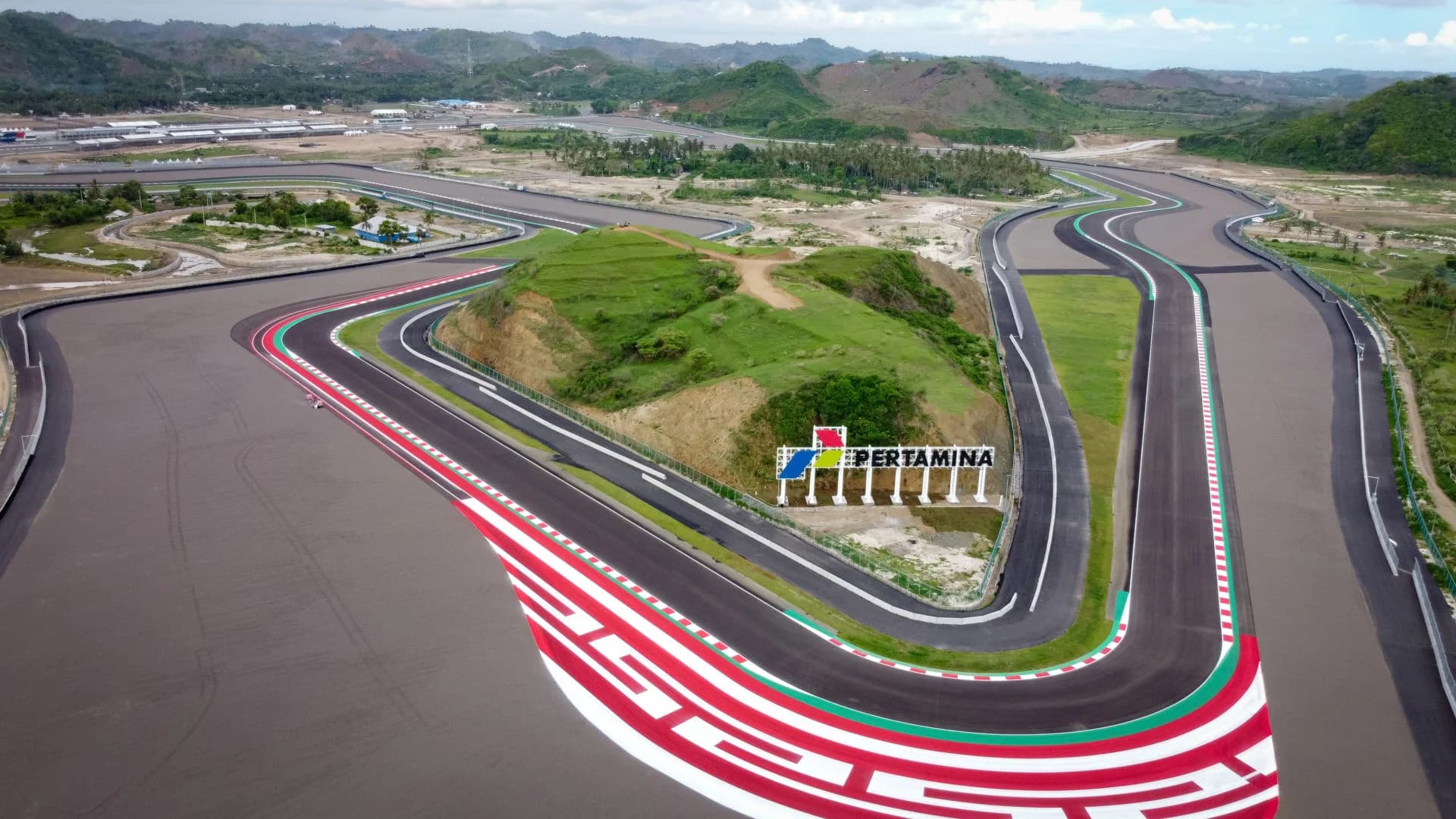
The Pertamina Mandalika International Street Circuit might seem like an odd anchor for a tourism megaproject. Most resort destinations lead with beaches or cultural attractions. But the circuit serves a strategic purpose beyond hosting motorcycle races. It creates an annual global media event—300+ million broadcast viewers—that puts Lombok on the map in a way that no marketing budget could achieve.
The government isn't subtle about its intentions. Mandalika has been designated a National Strategic Project, qualifying investors for tax holidays of up to 20 years. Land tenure within the SEZ extends to 80 years. Foreign ownership is permitted at 100%. The message to international capital is clear: we're open for business, and we're making it easy.
The MotoGP Catalyst
Skeptics questioned whether a racing circuit could anchor a tourism ecosystem. The early results suggest it can.
The inaugural MotoGP race in 2022 drew 102,801 spectators—impressive for a brand-new venue in a relatively undeveloped region. But the real story is the trajectory since:
| Year | Total Attendance | Year-over-Year Growth | Economic Impact |
|---|---|---|---|
| 2022 | 102,801 | First year | Rp 4.5 trillion ($287M) |
| 2023 | 102,929 | +0.1% | Rp 4.3 trillion ($274M) |
| 2024 | 121,252 | +17.8% | Rp 4.8 trillion ($305M) |
| 2025 | 140,324 | +15.7% | Rp 4.8 trillion ($289M) |
The 2025 edition set records. Hotel occupancy in Mandalika hit 100% during race weekend. Across greater Lombok, occupancy reached 93%. Even Mataram, the provincial capital 45 minutes away, saw 90% occupancy. The event supported 120 local MSMEs—double the number from 2024.
More importantly, Indonesia has secured a contract with Dorna Sports to host MotoGP through 2031. That's six more years of guaranteed global visibility, infrastructure investment, and proof-of-concept moments for potential investors.
The strategic logic is straightforward: racing tourism drives infrastructure investment, which enables broader tourism, which justifies more infrastructure. It's a flywheel, and the circuit is the mechanism that gets it spinning.
International hotel brands have noticed. Pullman, Club Med, Marriott, and InterContinental are all slated for the development. In April 2025, a joint venture between Indonesian, Japanese, and Dubai-based firms signed a $124 million agreement for a five-star Luxury Brand Collection hotel on Tanjung Aan Beach. The property is scheduled to open in 2027 with 200 suites and villas.
Of the 10,533 hotel rooms planned for Mandalika, only 965 are currently operational. That's 9% of target capacity. For investors, that gap between current state and future state is either a warning sign or an opportunity—depending on your risk tolerance and time horizon.
The Real Estate Arbitrage
The investment thesis for Lombok isn't just tourism growth. It's land price convergence.
Consider the current price gap between Lombok and Bali:
| Location | Price per Are (100m²) | USD per sqm |
|---|---|---|
| Kuta, Lombok (near Mandalika) | Rp 150-250 million | $94-156 |
| Canggu, Bali | Rp 1.9-2.5 billion | $1,188-1,563 |
| Discount | — | 87-90% |
That's not a typo. Prime land in Lombok's fastest-developing corridor costs roughly one-tenth of equivalent land in Bali's hottest market.
The question is whether that discount reflects fundamental differences in value—or a temporary lag that will close as Mandalika develops.
The appreciation data suggests the latter. Land in Kuta and Selong Belanak has been appreciating at 15-25% annually, according to local real estate firms. Villa prices increased 20-25% over the 12 months ending in late 2024. By contrast, Bali's mature markets are seeing 5-10% annual appreciation—still healthy, but reflecting a market that's already priced in much of its growth.
October 2025 brought regulatory changes that further tilted the playing field toward foreign investors. The minimum paid-up capital for a PT PMA (foreign investment company) dropped 75%, from Rp 10 billion to Rp 2.5 billion—roughly $150,000. Property developers can now count land toward their total investment minimums. The barrier to entry, already lower than Bali, got lower still.
The Airbnb data tells its own story. Bali has 37,567 active listings. Lombok South has 953. That's a 39:1 ratio. Yet Lombok South's average occupancy rate (67%) is actually higher than Bali's (65%), and the average daily rate ($83) isn't far behind ($98). The implication: Lombok has demand, but almost no supply. For vacation rental investors, that's the definition of an inefficient market.
The Skeptic's Case
Mega-projects in emerging markets have a history of overpromising. The question isn't whether Mandalika sounds impressive on paper—it's whether the vision will actually materialize.
The honest answer is: it's complicated.
Of the Rp 17 trillion committed to Mandalika, only Rp 5.73 trillion has been realized—about 33.7%. The ITDC carries Rp 4.6 trillion in debt from circuit construction. The World Superbike Championship, which was supposed to provide a second anchor event alongside MotoGP, departed in 2024. Infrastructure outside the immediate SEZ zone—roads, utilities, public services—is still catching up.
There are also harder-to-quantify concerns. The Sasak people, Lombok's indigenous community, have faced displacement as the project expanded. A Pulitzer Center investigation documented land disputes dating back to the Suharto era, when the original acquisition occurred through means that would not survive modern scrutiny. Development that enriches international investors while displacing local communities is not sustainable tourism—it's extraction with better marketing.
The counterarguments exist. A 33% realization rate is actually normal for decade-scale infrastructure projects; most of the committed capital is tied to hotels and resorts that will only break ground as demand materializes. The MotoGP contract through 2031 provides stability that most emerging destinations lack. Connectivity is improving—direct flights from Darwin launched in April 2025, and Perth routes are in discussion.
But investors should enter with clear eyes. Lombok is not a sure thing. It's a calculated bet that Indonesia can execute a complex, multi-decade infrastructure project while maintaining political and regulatory stability. That's a lot of variables.
The Comparison Nobody Makes
Here's a thought experiment: What if the right comparison isn't Lombok 2025 versus Bali 2025, but Lombok 2025 versus Bali 2004?
In 2004, Bali received approximately 1.5 million international visitors. Infrastructure was limited. The airport was small. The roads were bad. Most of the luxury resorts that now define the island hadn't been built. Land in Seminyak that now sells for $1,500/sqm could be had for a fraction of that price.
Lombok in 2025 received roughly 800,000 foreign tourists in the first nine months of the year. Its airport, capable of handling 7 million passengers annually, is operating at about 35% capacity. Hotel rooms stand at 9% of planned capacity. The infrastructure is being built, but it's not done.
The structural undersaturation is the point. If you believe Lombok will follow Bali's development trajectory—even at a slower pace, even with setbacks—then current prices represent a discount to future value that the market hasn't fully priced in.
If you're skeptical that lightning strikes twice in the same archipelago, or that Indonesia can execute a 20-year infrastructure vision without major stumbles, then the discount is appropriate compensation for risk.
Both perspectives are defensible. What's not defensible is ignoring the asymmetry. The downside on Lombok land is probably not zero—this isn't speculative crypto—but the upside, if the Mandalika thesis plays out, could be substantial.
What Happens Next
The next five years will determine whether Indonesia's $3 billion bet pays off.
Key milestones to watch:
2026: MotoGP returns October 9-11. Attendance trajectory will signal whether the event has legs or is plateauing. Phase II of Mandalika infrastructure (2024-2026) should show visible progress.
2027: The Luxury Brand Collection hotel on Tanjung Aan is scheduled to open. If major international brands start operating successfully, it validates the market.
2028-2030: The middle years of the MotoGP contract. By now, the question of whether Lombok can attract tourists outside of race weekends should have an answer.
2031: MotoGP contract decision point. Renewal would signal long-term viability. Non-renewal would raise serious questions about the anchor event model.
For the Indonesian government, the stakes extend beyond Lombok. Mandalika is a test case for the "10 New Balis" strategy. If it works, the playbook gets replicated across the archipelago. If it fails, Indonesia is stuck with an overcrowded Bali and a white elephant on Lombok.
The Bottom Line
Indonesia is making a calculated bet that it can replicate Bali's tourism success while avoiding Bali's sustainability failures. The $3 billion poured into Mandalika isn't charity—it's an investment thesis backed by sovereign capital and multilateral development bank funding.
The early signals are encouraging. MotoGP attendance is growing. Hotel brands are committing. Real estate prices are appreciating faster than Bali's. Regulatory barriers are falling.
But megaprojects are marathons, not sprints. The 67% of committed investment that hasn't materialized yet will determine whether Mandalika becomes a world-class destination or an ambitious cautionary tale.
For investors, the question is straightforward: Do you believe Indonesia can execute? If yes, Lombok at current prices offers a rare combination of government-backed development, structural undersupply, and entry points an order of magnitude below comparable markets.
For travelers, the calculus is simpler. Go now. The beaches are empty, the surf is uncrowded, and the prices haven't caught up to the potential.
Before it really does become the next Bali.
Data sources: ANTARA News, Jakarta Post, Indonesia Tourism Development Corporation (ITDC), Asian Infrastructure Investment Bank (AIIB), BPS NTB, Airbtics, Travel Weekly Asia. All figures as of January 2026 unless otherwise noted.
Villa Ombak Team
Villa Management
The dedicated team at Villa Ombak, sharing local insights and villa updates to help you make the most of your Lombok experience.